
A universal joint for sockets is a flexible drive accessory that allows a socket to operate at an angle rather than remaining perfectly aligned with the ratchet or other drive tool. It is placed between the socket and a compatible drive tool, such as a ratchet, extension, breaker bar, or impact tool.
This additional flexibility is especially useful when a fastener is located in a tight, crowded, or obstructed area. Engine components, pipes, brackets, frame rails, housings, suspension parts, and other surrounding structures can prevent a conventional straight tool from reaching a bolt or nut directly. Instead of removing nearby components or repeatedly changing the position of the entire tool assembly, a universal joint can provide an alternative path to the fastener.
Universal joints are commonly useful in:
- Automotive repair – reaching bolts around engines, transmissions, and suspension components.
- Agricultural and Farm equipment maintenance – accessing fasteners in large and crowded machinery.
- General Mechanical work - a practical addition to an existing socket set.
- Hand-tool applications – providing additional flexibility when working in confined spaces.
- Compatible impact-tool applications – helping transfer rotational force when angled access is required.
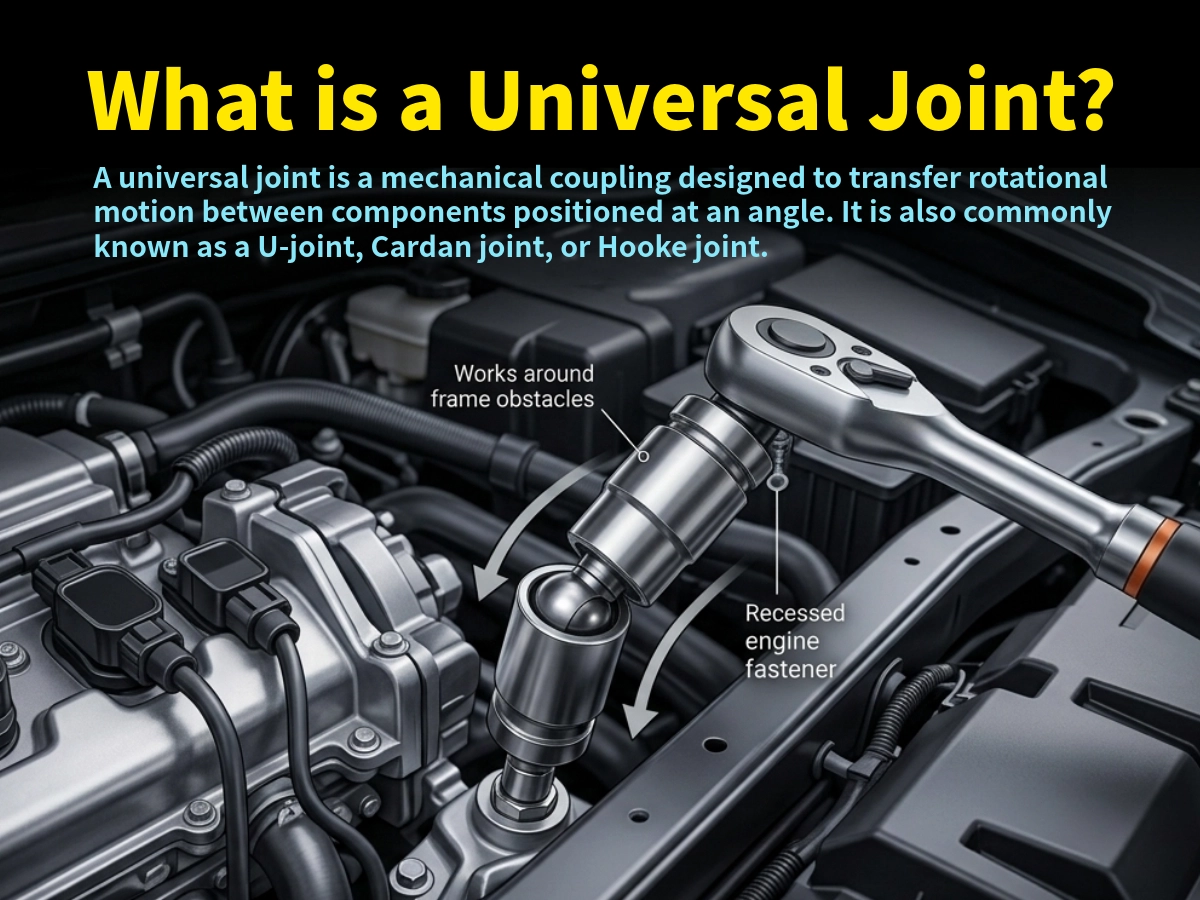
What is a Universal Joint?
A universal joint is a mechanical coupling designed to transfer rotational motion between components positioned at an angle. It is also commonly known as a U-joint, Cardan joint, or Hooke joint.
Universal Joints in Socket Tools
A socket universal joint connects a drive tool to a socket while allowing the two components to operate at an angle. Depending on the application, the drive side may be connected to a ratchet, breaker bar, extension, cordless driver, pneumatic tool, or compatible impact wrench.
This is useful when a fastener cannot be approached directly because something is blocking the normal path. A universal joint provides another option by allowing the socket to remain engaged with the fastener while the drive tool is positioned at a more convenient angle.
A conventional universal joint uses a central cross, or spider, to connect two yokes. As the input side rotates, the joint transfers motion to the output side while allowing the two sides to operate at an angle.
Important Limitations
Angular flexibility has limits. Users should follow the manufacturer's specified:
CONSIDERATION | WHAT TO CHECK: |
Working Angle | Maximum permitted operating angle |
Load Capacity | Amount of torque the joint can handle |
Drive Size | Compatibility with the tool and socket |
Application | Whether the joint is intended for a specific task |
Universal Joints in Automotive and Equipment Repair
Socket universal joints are particularly useful in automotive repair, agricultural equipment maintenance, and general mechanical work. They can provide alternative access to fasteners around:
- Engines
- Transmissions
- Suspension components
- Frames
- Brackets
- Machinery housings
This can allow technicians to reach fasteners without requiring the entire tool assembly to remain perfectly straight.
What Makes a Socket Universal Joint Different?
A socket universal joint is specifically designed for socket-drive tools and must be matched to the appropriate drive size and socket. It should also be selected according to the intended application.
What Is a Universal Joint Socket Adapter?
A universal joint socket adapter is a specialized drive accessory that introduces angular flexibility between a ratchet handle and a socket fastener. Built around a swiveling yoke mechanism, it grants up to a 45-degree clearance offset, empowering technicians to navigate tight engine bays, awkward machinery frames, and obstructed industrial enclosures where a standard straight extension fails.
Built for Extreme Angles and Effortless Power
Struggling with hard-to-reach bolts? Our Universal Joint Socket Adapter is the ultimate problem solver for your toolset. Engineered with a smooth 30-degree swivel head, this tough adapter lets you work around tight corners, hidden brackets, and awkward engine bays with maximum ease. Instead of removing nearby parts just to get a straight angle, simply attach our joint adapter to your ratchet or impact wrench and get the job done faster.
Crafted from premium Chrome Molybdenum steel, our adapters are built to resist heavy wear, rust, and high torque output. The solid construction ensures consistent power transfer from your tool directly to the fastener, giving you full control without slipping or binding.
Key Features and Professional Performance
- Durable Cr-Mo Construction: Handles severe impact drive forces without cracking or deforming under stress.
- Smooth Swivel Action: Provides flexible rotation in tight spaces where standard drive extensions cannot fit.
- Secure Pinless Joint: Keeps the connection stable and prevents wobble during high-speed applications.
- Universal Tool Compatibility: Fits seamlessly with your existing standard socket sets, ratchets, and power drivers.
How Does a Universal Joint Socket Work?
A universal joint socket operates on the principle of a Hooke's joint, converting continuous rotational force across non-linear paths. By utilizing two dynamic yokes connected at right angles through a central cross-pin core, it enables smooth power transmission even when driving fasteners at offset angles up to 45 degrees. This clever geometry eliminates the line-of-sight requirement between your ratchet and the bolt, making short work of deep engine bays, tight frame rails, and crowded mechanical assemblies.
Our high-performance socket line maximizes this physical mechanism using precision-machined pivot pins and a low-profile housing. This design dramatically minimizes rotational friction, prevents annoying binding under heavy loads, and ensures max torque transfer to the target fastener without slippage.
Torque Dynamics and Structural Integrity
Mechanical engineering studies from SAE International demonstrate that operating drive accessories at severe working angles reduces output torque according to cosine function law:
Transmitted Torque = Input Torque × Cosine(Working Angle) |
Working at extreme angles also introduces fluctuating lateral forces that stress internal pins. To prevent premature shearing, our heavy-duty universal joint sockets are forged from heat-treated Chrome Molybdenum steel. Featuring reinforced wall geometries and dynamic stress-relief channels, they easily absorb high-impact torque pulses while maintaining steady continuous alignment. This rugged durability ensures your tools remain dependable under high-stress conditions.
Essential Workflow Advantages
Unmatched Accessibility: Reach obstructed fasteners behind firewalls or structural framing without removing neighboring components.
Seamless Tool Integration: Connects effortlessly to standard air drivers, impact guns, and hand ratchets for maximum versatility.
Enhanced User Safety: Solid pin retention prevents tool separation under dynamic stress, protecting technicians and surrounding hardware.
Why Use a Universal Joint With a Socket?
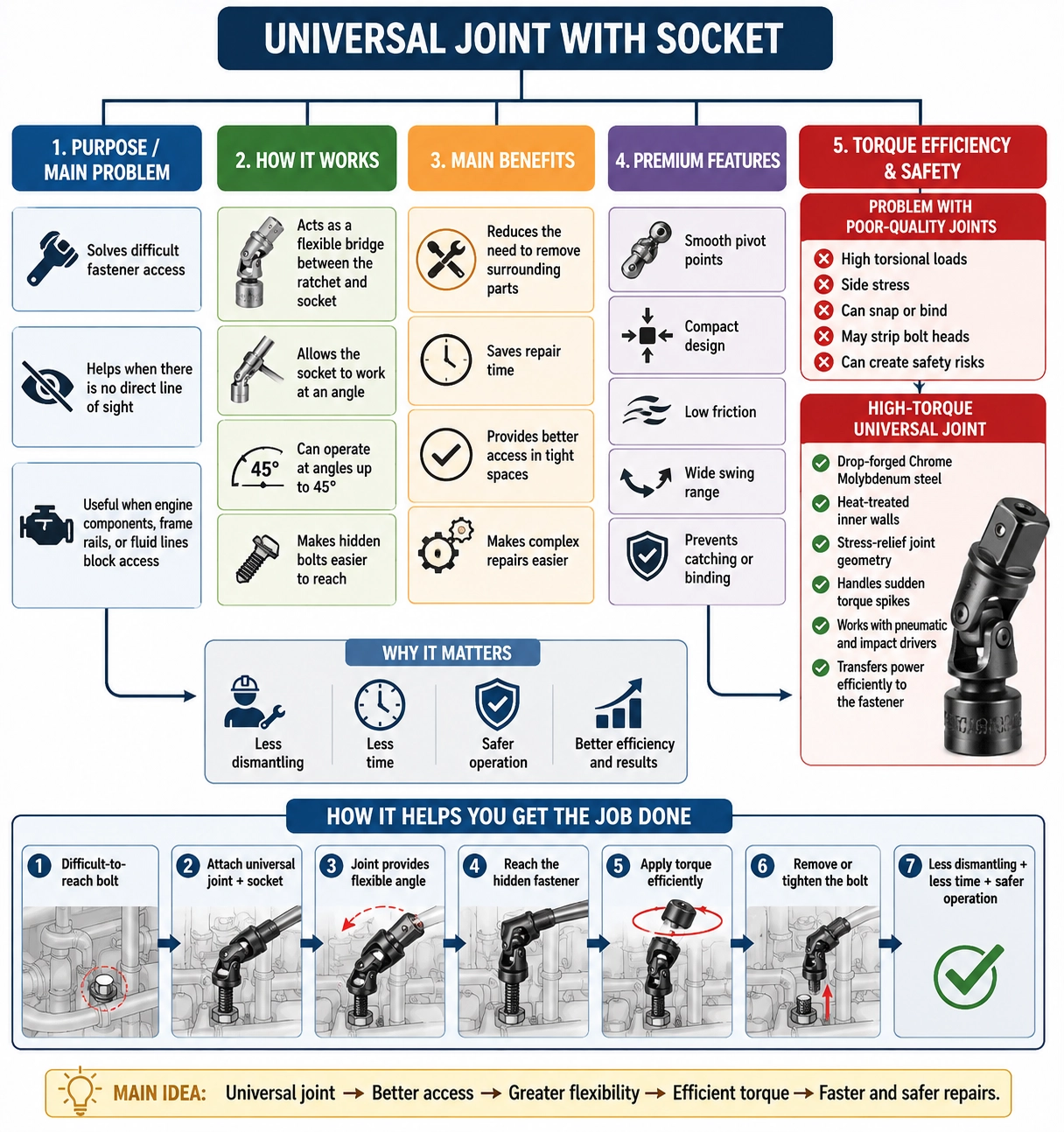
Using a universal joint with a socket solves the common headache of line-of-sight fastener access. When engine components, frame rails, or fluid lines block direct ratchet alignment, a standard straight extension simply cannot fit. A universal joint acts as a flexible bridge, allowing you to turn bolts at angles up to 45 degrees. This flexibility removes the tedious necessity of dismantling surrounding hardware just to reach a single hidden bolt, saving hours of manual labor on complex repairs.
Our premium universal joint adapters feature ultra-smooth pivot points and a compact footprint, allowing maximum clearance inside congested work spaces. By combining low friction with a high swing range, our adapters help you maintain steady turning momentum without catching or binding on nearby components.
Maximizing Torque Efficiency and Tool Safety
Mechanical testing protocols from ASME B107 standards highlight that working at offset angles subjects drive accessories to high torsional loads and side stress. Lower-quality joints can snap or bind under heavy strain, stripping bolt heads or injuring mechanics.
Our high-torque universal joint socket line addresses this problem directly. Forged from drop-forged Chrome Molybdenum steel, each unit features heat-treated inner walls and dynamic stress-relief joint geometry. This heavy-duty build absorbs sudden torque spikes from pneumatic and impact drivers while delivering continuous, efficient power straight to the fastener.
Work Around Obstructions
Obstructions are one of the most common reasons to use a universal joint. Brackets, pipes, frame rails, housings, suspension components, and other parts can prevent a ratchet or impact wrench from aligning directly with a fastener.
Common obstructions include:
- Brackets
- Pipes
- Engine components
- Frame rails
- Housings
- Suspension components
- Structural parts
- Other surrounding equipment
Without angular flexibility, the user may have to remove the obstruction, change tools, approach the fastener from another direction, or repeatedly reposition the socket assembly.
A universal joint provides another practical option: the socket can remain engaged with the fastener while the drive tool operates at an angle.
Example:
Imagine a bolt located behind an engine component. A straight ratchet cannot reach the bolt because the surrounding parts block it. Instead of removing those parts, you can place the socket directly on the bolt and attach a universal joint and extension. The ratchet can then be held at an angle while still turning the bolt.
This makes the universal joint especially useful for hard-to-reach fasteners, crowded engine compartments, and complex automotive repairs. With a universal joint, the socket remains seated on the fastener, while the ratchet or extension can be positioned at an angle. The joint bends to accommodate the different positions and transfers the turning force from the tool to the socket.
How a Universal Joint Helps
The key advantage is the ability to work around an obstruction rather than directly through it.
| Conventional Straight Connection | Universal Joint Connection |
| Tool and socket must remain closely aligned | Tool can operate at an angle to the socket |
| Obstructions may block the direct path | Obstructions can sometimes be worked around |
| May require repositioning the tool | Provides an additional tool path |
| May require removing surrounding components | Can reduce the need for unnecessary component removal |
Practical Application Advantages
Streamlined Repair Workflows: Reach recessed spark plugs, suspension bolts, and hidden fluid lines without disassembling nearby engine components.
Flawless Drive Compatibility: Integrates seamlessly across standard pneumatic impact guns, cordless drivers, and hand ratchets for maximum shop versatility.
Long-Lasting Dependability: Impact-rated alloy construction prevents cracking, joint loosening, or surface corrosion during intense daily use.
Reach Tight and Confined Spaces
Working in narrow areas can make even simple tasks more demanding. When equipment, pipes, walls, or machinery block access, workers may need to stretch, twist, bend, or reach farther than is comfortable. According to NIOSH, excessive reaching and awkward postures are recognized ergonomic risk factors that can contribute to muscle fatigue and work-related musculoskeletal disorders.
Our professional universal joint socket lineup features low-profile drive heads and smooth-pivoting joints engineered specifically for restricted quarters. Designed to minimize overall tool clearance while maximizing swing movement, our products let you slide easily behind firewalls, beneath exhaust manifolds, and into narrow equipment housings.
Think of the challenge this way:
Limited space → difficult positioning → greater physical effort → slower, less comfortable work
When space is restricted, reach and maneuverability matter. Our products are designed to help users approach tight areas while maintaining better control over the task.
They can be especially useful for:
- Reaching behind equipment
Access components positioned behind or between larger structures without unnecessary body movement. - Working around obstacles
Navigate confined areas where conventional equipment may be too large or difficult to position. - Handling detailed tasks
Maintain better reach and control when inspection, adjustment, maintenance, or repair requires precision.
Research on unusual or restricted working postures has found that workers may experience reduced strength and increased musculoskeletal complaints in such positions.
Key advantages at a glance:
Compact access — Designed for areas with limited clearance.
Improved maneuverability — Helps users work around nearby components.
Greater control — Supports more precise handling during demanding tasks.
Practical efficiency — Reduces unnecessary repositioning during work.
NIOSH recommends considering changes to tools, equipment, and work areas when reducing ergonomic risks.
Reduce the Need for Tool Repositioning
Consider the difference in a typical task:
Old approach — reposition the tool whenever the fastener sits at an awkward angle.
Improved approach — keep the socket connected and use the joint to reach the fastener with less repositioning.
That small change can make routine work feel more controlled. It also reduces the temptation to force a socket into an unsuitable position, which can make handling less comfortable. A universal joint is therefore not merely an extra connector; it is a practical accessory for improving access and efficiency.
For regular repair work, the benefit is straightforward: fewer adjustments, easier access, and a more comfortable working position. A universal joint is a small addition, but it can improve the usefulness of an entire socket set. Keeping one suitable joint in the kit can save repeated setup changes when space is limited during routine fastening tasks at work.
Practical Benefits in Regular Repair Work
For routine maintenance and repair tasks, the benefits are straightforward:
Fewer adjustments
→ Less time spent repositioning the tool.
Better access
→ Easier reach to fasteners located behind or around obstacles.
Greater flexibility
→ Allows the drive tool to operate from a more convenient angle.
Improved handling
→ Helps avoid forcing the tool into uncomfortable positions.
Greater efficiency
→ Makes repeated fastening and removal tasks smoother.
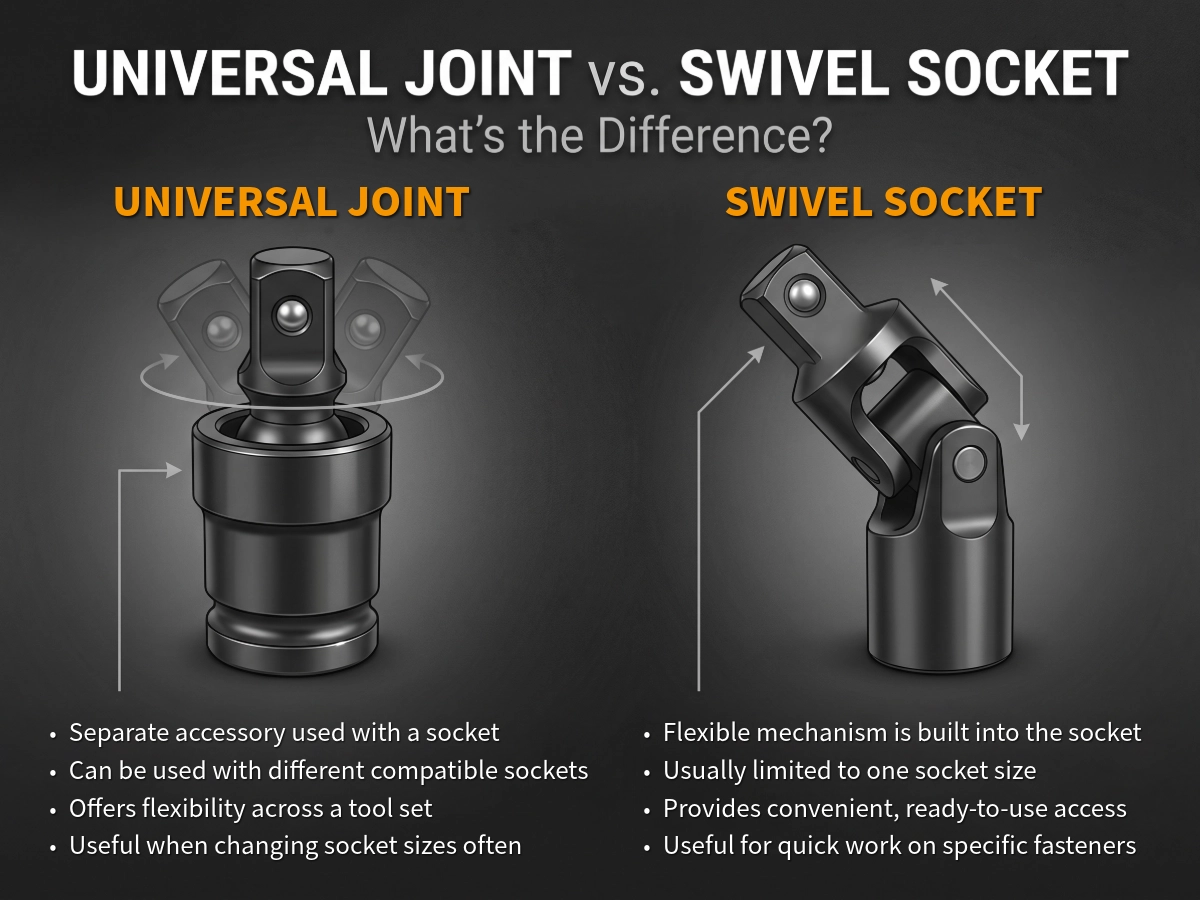
Universal Joint vs. Swivel Socket: What's the Difference?
Universal Joint vs. Swivel Socket
Choosing the right socket accessory can make a noticeable difference when working around tight spaces, blocked fasteners, or difficult angles. Although universal joints and swivel sockets perform similar tasks, their designs and practical uses are not exactly the same.
A Quick Comparison
| UNIVERSAL JOINT | SWIVEL SOCKET |
| Separate accessory used with a socket | Flexible mechanism is built into the socket |
| Can be used with different compatible sockets | Usually limited to one socket size |
| Offers flexibility across a tool set | Provides convenient, ready-to-use access |
| Useful when changing socket sizes often | Useful for quick work on specific fasteners |
A universal joint works as a flexible connection between the drive and socket. Its main purpose is to transmit turning force when the two parts are not perfectly aligned. Engineering literature confirms that universal joints are designed to handle angular misalignment, although operating angle and torque affect their performance and service life.
A swivel socket follows a similar principle but places the flexible mechanism directly into the socket. This creates a compact tool that can be convenient when the same socket size is repeatedly required. For technicians who regularly work with several socket sizes, however, a separate universal joint can offer greater flexibility because one accessory can serve multiple compatible sockets.
Why can a Universal Joint be a practical choice?
One connection, several possibilities:
- Connect it to different compatible sockets
- Reach fasteners from a more suitable angle
- reduce repeated tool repositioning
- Keep the toolkit more adaptable
One joint → multiple compatible sockets → fewer tool changes.
This arrangement can make work more efficient without requiring a large collection of specialized sockets. It is especially helpful around machinery, automotive components, and other restricted spaces where a straight approach is difficult.
Still, flexibility should be used responsibly. Authoritative engineering guidance notes that joint selection depends on factors such as torque, speed, and operating angle.
Therefore, the better option depends on the job. A swivel socket suits quick, size-specific tasks, while a universal joint is often more versatile for varied work. For professionals seeking an adaptable addition to an existing socket set, our product provides a sensible balance of access, convenience, and versatility. It is a small tool that can make difficult fastening jobs easier without requiring a complete change to the existing setup.
What Working Angle Does a Universal Joint Provide?
A universal joint is designed to give a socket greater freedom of movement when a fastener cannot be reached from a straight position. In many standard designs, the working angle can reach up to 45°, although the exact limit depends on the joint’s construction, size, and intended application. Engineering references also identify 45° as a common maximum angle for a single universal joint.
Understanding the Angle
Think of the joint as creating a flexible connection between the socket and the drive tool:
- Straight access → 0°
- Moderately angled access → 15°–30°
- Maximum for many single joints → up to 45°
This added movement is particularly useful around engine components, machinery, brackets, and other confined areas. Instead of repeatedly removing and repositioning the tool, the user can maintain the connection while approaching the fastener from a more suitable direction.
Our Universal Joint for Sockets is designed to provide this kind of flexibility, helping make difficult fastening work more manageable. A 45° working angle can be valuable when a conventional straight socket cannot line up properly with the fastener. Similar socket designs are available with a 45° working angle and 360° rotational movement for confined applications.
For routine maintenance and repair tasks, a reliable universal joint is a valuable addition to any socket set. By providing greater flexibility and easier access in confined spaces, it reduces unnecessary tool repositioning and helps make difficult fastening work smoother and more precise. Choosing a dependable universal joint means gaining greater versatility from the tools you already use, making it a practical investment for more efficient work.